



TAZARA: A historic, iconic diplomatic tool for Tanzania, Zambia and China
THE Tanzania–Zambia Railway Authority (TAZARA), famously known as the freedom railway, stands as one of Africa’s most iconic symbols of Pan-African solidarity, South–South cooperation, and strategic diplomacy during the Cold War.
Constructed between 1970 and 1975 by Tanzania, Zambia, and the People’s Republic of China, the railway was designed to liberate landlocked Zambia from economic dependence on white-minority-ruled Southern Africa by providing a secure outlet to the Indian Ocean through the port of Dar es Salaam.
Western powers, including the United States and the United Kingdom, had rejected the project as economically unjustifiable. China stepped in with an interest-free loan of 988 million Yuan, making TAZARA the largest Chinese foreign aid project at the time.
Beyond infrastructure, it represented political courage, anti-imperialist solidarity, and a vision of African self-reliance. In many ways, TAZARA laid the foundation for the enduring Africa–China partnership now institutionalized through the Forum on China–Africa Cooperation (FOCAC).
Cold war politics and African liberation
The origins of TAZARA are inseparable from the Cold War and Africa’s liberation struggles. The idea of a rail link connecting Central and Southern Africa to the eastern seaboard dates back to 1947, but colonial administrations repeatedly dismissed it for political and economic reasons. After independence, Tanzania’s founding President Mwalimu Julius Nyerere and Zambia’s first President Dr. Kenneth Kaunda revived the idea as a strategic necessity.
The urgency intensified after Rhodesia’s Unilateral Declaration of Independence in 1965 under Ian Smith. Zambia, a frontline state supporting liberation movements, depended heavily on southern rail and road routes controlled by hostile regimes.
The possibility of economic strangulation made it clear that Zambia’s sovereignty required an alternative route to the sea. TAZARA thus became not only an economic project but a lifeline for political independence.
China steps in
After failed appeals to Western governments, the World Bank, and the United Nations, Tanzania and Zambia turned to China. In 1967, the three governments signed an agreement in Beijing to construct the railway.
Chairman Mao Zedong’s decision was remarkable: China itself was facing severe domestic poverty and food insecurity, yet it committed to financing, designing, and building a 1,860-kilometre railway across some of Africa’s most difficult terrain.
According to Joseph Butiku, former Private Secretary to Mwalimu Nyerere, Mao raised the TAZARA issue even when Nyerere hesitated to table it. Mao famously said, “China is not rich. We are poor too. But we will fasten our belts to build this railway.” When Nyerere finally confirmed Tanzania’s need, Mao replied simply: “You have it.”
This moment encapsulated the spirit of the project—solidarity rooted not in wealth, but in shared struggle and mutual respect.
Constructing the railway
The Tanzania–Zambia Railway Authority was established in 1968. Surveys and designs conducted by Chinese engineers contradicted earlier colonial assessments and confirmed the project’s feasibility. In July 1970, China formally agreed to provide an interest-free loan repayable over 30 years, covering construction, rolling stock, stations, workshops, and a training school.
Construction began in October 1970, simultaneously from Dar es Salaam and Kapiri Mposhi. The engineering challenges were immense. The most difficult section—between Mlimba and Makambako—required excavation of 20 million cubic meters of earth, construction of 46 bridges, 18 tunnels, and hundreds of culverts. By August 1973 the line crossed into Zambia, and by June 1975 it reached Kapiri Mposhi—two years ahead of schedule.
At its peak, the workforce included over 38,000 Tanzanian and Zambian workers and 13,500 Chinese engineers and technicians. Tragically, more than 160 workers lost their lives during construction, including 64 Chinese nationals. TAZARA officially commenced full operations on 14 July 1976 after being handed over to Tanzania and Zambia.
Human bonds and cultural exchange
Beyond steel and concrete, TAZARA forged deep human connections. Chinese engineers worked alongside young Tanzanians and Zambians, transferring skills in welding, engineering, and railway operations. Many Chinese workers learned Kiswahili and adhered to strict discipline, earning admiration from local communities. For young Tanzanian men, working on TAZARA became a rite of passage.
In one memorable speech, the late Mwalimu Nyerere recounted how a Chinese team leader thanked Tanzanians for helping build the railway. Nyerere reflected on who truly owed gratitude, concluding that Tanzania had a duty to thank China for helping Africans build infrastructure for their own benefit.
Economic and strategic impact
For over five decades, TAZARA has played a vital role in linking Tanzania and Zambia, opening up remote regions, stimulating trade, and supporting rural livelihoods. Towns along the line grew into economic and cultural centers. The railway also helped break apartheid-era economic blockades and supported liberation movements across Southern Africa.
Despite operational challenges over the years, TAZARA remains an extraordinary achievement. Stretching 1,156 miles, it runs through jungles, mountains, and plains, serving not only as transport infrastructure but also as a social artery—providing water access, footpaths, and connectivity where none previously existed.
Both Nyerere and Kaunda praised the railway as a model of genuine partnership. Kaunda famously said, “A friend in need is a friend indeed.” Africans widely celebrated TAZARA as a “road to freedom” and a blueprint for South–South cooperation.
Revitalization of TAZARA
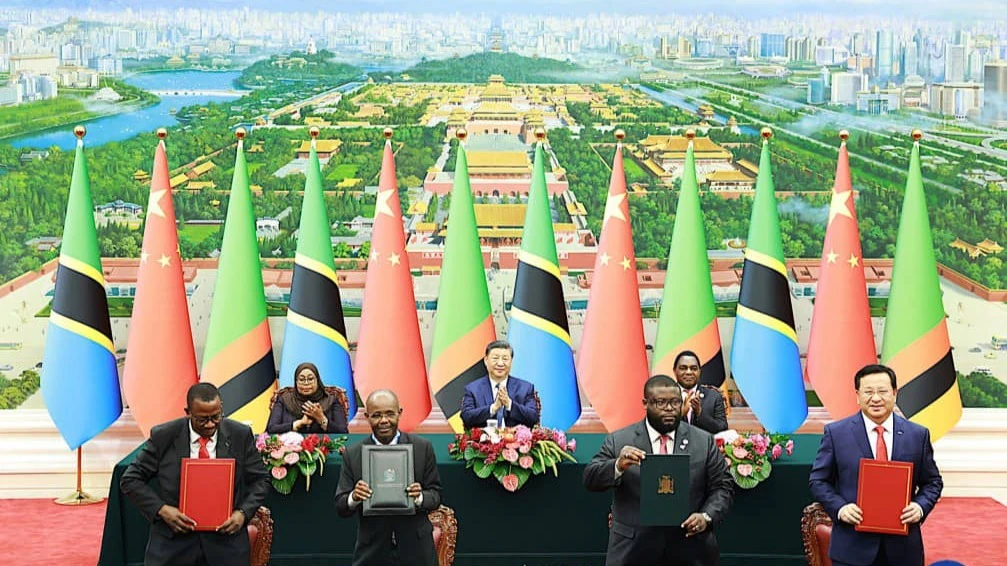
Recognizing the weight and importance of TAZARA, under the strategic leadership of President Xi Jinping of the People’s Republic of China, President Samia Suluhu Hassan of the United Republic of Tanzania and President Hakainde Hichilema of the Republic of Zambia, the revitalization project of the TAZARA Railway was launched on November 20, 2025.
In ensuring that TAZARA Railway continue to deliver greater and more lasting benefits to Tanzania and Zambia and the neighboring countries, the three governments have agreed to join hands once again to advance modernization that is just and equitable, open and win-win, eco-friendly, people-centered, featuring diversity and inclusiveness, and underpinned by peace and stability, and promote the building of TAZARA Railway Prosperity Belt.
This will help to advance further development of Tanzania, Zambia and China, explore the potential for regional development, and set a model for high-quality Belt and Road cooperation between China and Africa, strongly underpinned in the FOCAC.
The three parties commit to synergize the outcomes of the Forum on China-Africa Cooperation Beijing Summit 2024 as well as the Initiative on Supporting Africa's Industrialization, the Plan for China Supporting Africa's Agricultural Modernization and the Plan for China-Africa Cooperation on Talent Development proposed by President Xi Jinping with Tanzania's Development Vision 2050, Zambia's Eighth National Development Plan (2022-2026), Agenda 2063 of the African Union, and the United Nations 2030 Agenda for Sustainable Development and aspire to building a railway of freedom, building a railway of development, building a railway of friendship and partnership, building a railway for the people’s welfare, building a railway of green development and finally building a railway of regional harmony.
To achieve the six above-mentioned aspirations, the three parties will adhere to the "government-led, market-oriented, business-based and broadly participated" principle, fully leverage on the role of financial institutions, think tanks and specialized institutions, and encourage and support innovative cooperation models to promote integrated development along the Prosperity Belt.
In conclusion, the revitalization of TAZARA between Tanzania, Zambia and China still continue to mark great and true friendship that exists between China and Africa.
It continues to demonstrate how important South-South Cooperation could be the best model of development among nations of the South. China is the world’s dominant manufacturing powerhouse, leading global output due to its vast, integrated supply chains, large workforce which Africa has, government support, and historical advantages like low labor costs, producing a significant share of the world’s steel, electronics, textiles, and more, making it the world’s factory for countless products. African countries must position themselves to learn from China, a friend who is always ready to help. As the late President of Zambia once said, “China is a friend in need and a friend indeed”.
Omar Mjenga is a Senior Diplomat and President and Chief Executive Officer of Centre for International Policy-Africa
Top Headlines
Trending Stories











© 2026 IPPMEDIA.COM. ALL RIGHTS RESERVED